Home › Structural Shapes › I-Beam
The section that uses material most efficiently: the flanges take the bending, the web takes the shear. For spanning between two supports and carrying platforms and walkways. Pultruded by NA-ME Composite.
↳ give us the span and we will run the deflection check together
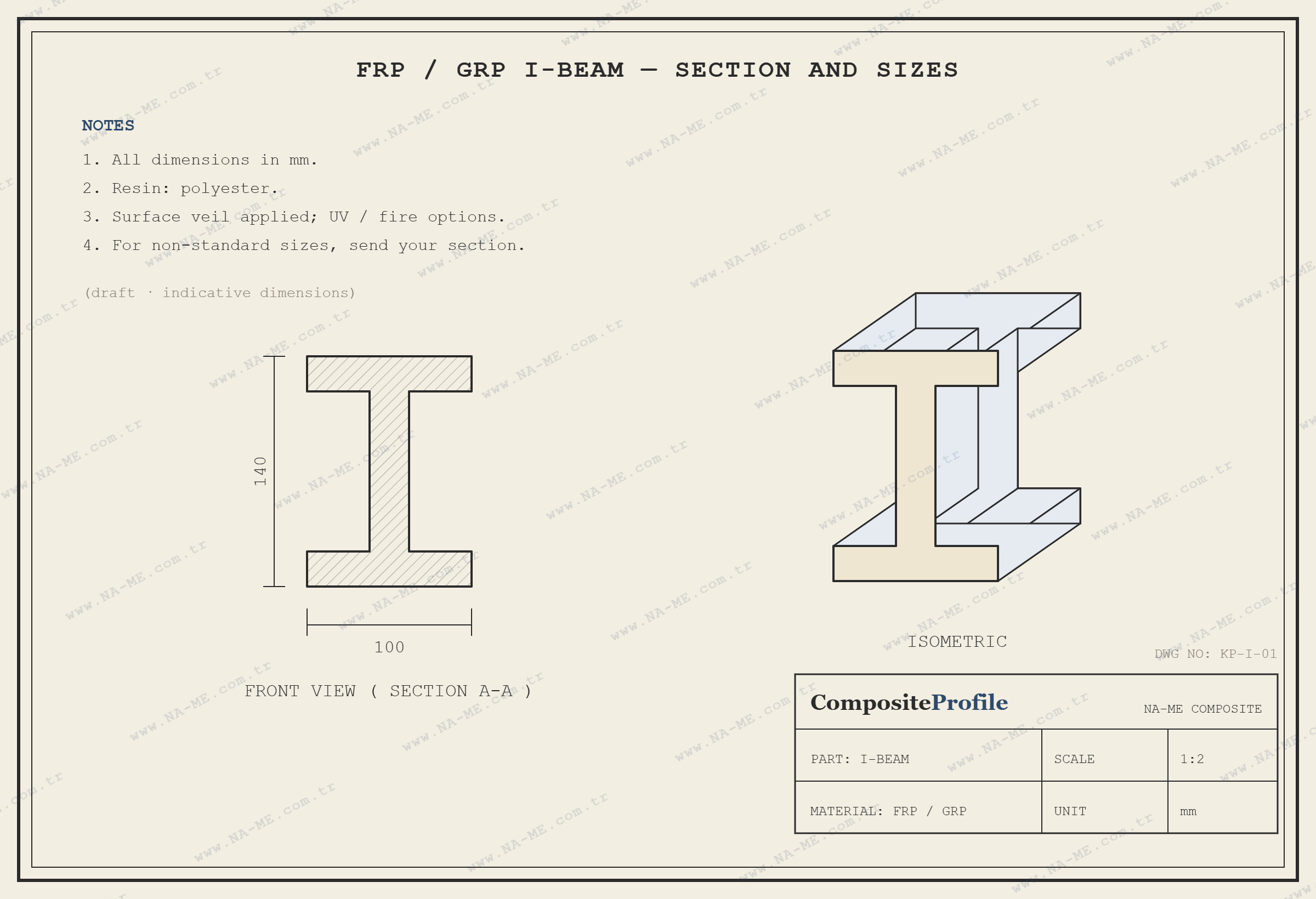
The I-beam carries most of its section area away from the neutral axis, into the top and bottom flanges. Bending moment is taken there as tension and compression, while the thin web between them takes the shear. That division of labor is why an I section gives the highest flexural stiffness per unit weight. If you have a span to cross between two supports, this is the first profile to look at.
FRP grating support beams in treatment plants, walkways over chemical tanks and basins, catwalk and platform systems, jetty members in marine structures and maintenance platforms in salty, humid air are the classic places for an I-beam. Because the fibers in a composite run mainly along the length, the section is usually governed not by strength but by the deflection limit. That is why sharing the clear span, the support layout and the load it will carry is the shortest route to the right section.
| Code | Height A (mm) | Flange B (mm) | Wall t (mm) | Weight (kg/m) |
|---|---|---|---|---|
| CPI-O-101 | 30 | 15 | 4 | 0,38 |
| CPI-O-102 | 40 | 15 | 4 | 0,60 |
| CPI-O-103 | 100 | 50 | 6 | 2,25 |
| CPI-O-104 | 150 | 75 | 6 | 3,31 |
| CPI-O-105 | 150 | 75 | 8 | 4,25 |
| CPI-O-106 | 180 | 90 | 10 | 5,90 |
| CPI-O-107 | 200 | 100 | 10 | 7,12 |
| CPI-O-108 | 250 | 125 | 10 | 9,16 |
| CPI-O-109 | 300 | 150 | 12 | 12,50 |
↳ On long spans a standard section may not be enough. Send the span and the load; if needed we will make the section to order.
In treatment, chemical and marine environments the web never blisters with rust, and the load-bearing section does not thin out over the years.
Far lighter than the steel beam doing the same job, so on many sites it goes up by hand instead of by crane.
In power plants and on wet platforms it never bridges a leakage current, so no extra insulation detail is needed.
Made in one piece, with no weld seam and none of the crack or rust starting points that come with one.
Give us the clear span, support spacing and the load to be carried; we will settle together on the h×b×t section and resin that meet your deflection limit. We price it against the job — dimensions are enough to start.