HomeApplications & SystemsApplications

where it is used

FRP Profile Applications by Industry

GRP and FRP composite profiles replace steel on sites where corrosion, weight and electrical insulation all matter at once. Below are the five fields we work in most often, why composite is chosen in each, and which sections come to the front.

↳ tell us the environment and we will choose the resin together

GRP handrail composite platform treatment basin

three questions first

When is a composite profile the right choice?

Not every site needs composite; but on some sites nothing else is a reasonable option. What decides the material is not a brand but the environment itself. Before recommending a section we settle these three headings.

  • How aggressive is the environment? Moisture, salt, chemical vapor, dosing liquid, wash water, temperature range and UV exposure.
  • What is the load and the span? What will sit on it, how many meters have to be spanned, and whether it is pedestrian traffic or equipment load.
  • Is electrical insulation required? Whether a non-conductive support is wanted around transformers, panels, switchyards or DC lines.

These three answers decide both whether a GRP profile is the right choice and how we will work with polyester resin.

What composite means on site

  • No rust, no rot — the painting and rust-removal line item disappears
  • Far lighter than steel — less need for cranes and heavy equipment
  • It conducts neither electricity nor heat — a safety margin on power and wet sites
  • It is non-magnetic — no trouble around sensitive equipment
  • Section and resin are chosen for the application — nothing is forced on you

no standard, just your site →

summary

Five main fields of use

You will find the detail for each of these headings a little further down.

Water & wastewater treatment

Constant moisture, dosing chemicals and a biological environment. Corrosion here is not a possibility, it is a certainty.

detail ↓

Energy & power

Non-conductive supports and handrails around transformers, panels and switchyards.

detail ↓

Marine & coastal

Jetties and platforms under salt spray, constant wet-dry cycling and wave action.

detail ↓

Solar power plants

Outdoor UV, wide sites, fast installation and insulation around DC lines.

detail ↓

Chemical & industrial

Acid and alkali vapor, spillage and aggressive cleaning. Resin selection is decisive here.

detail ↓

field 01

Water and wastewater treatment plants

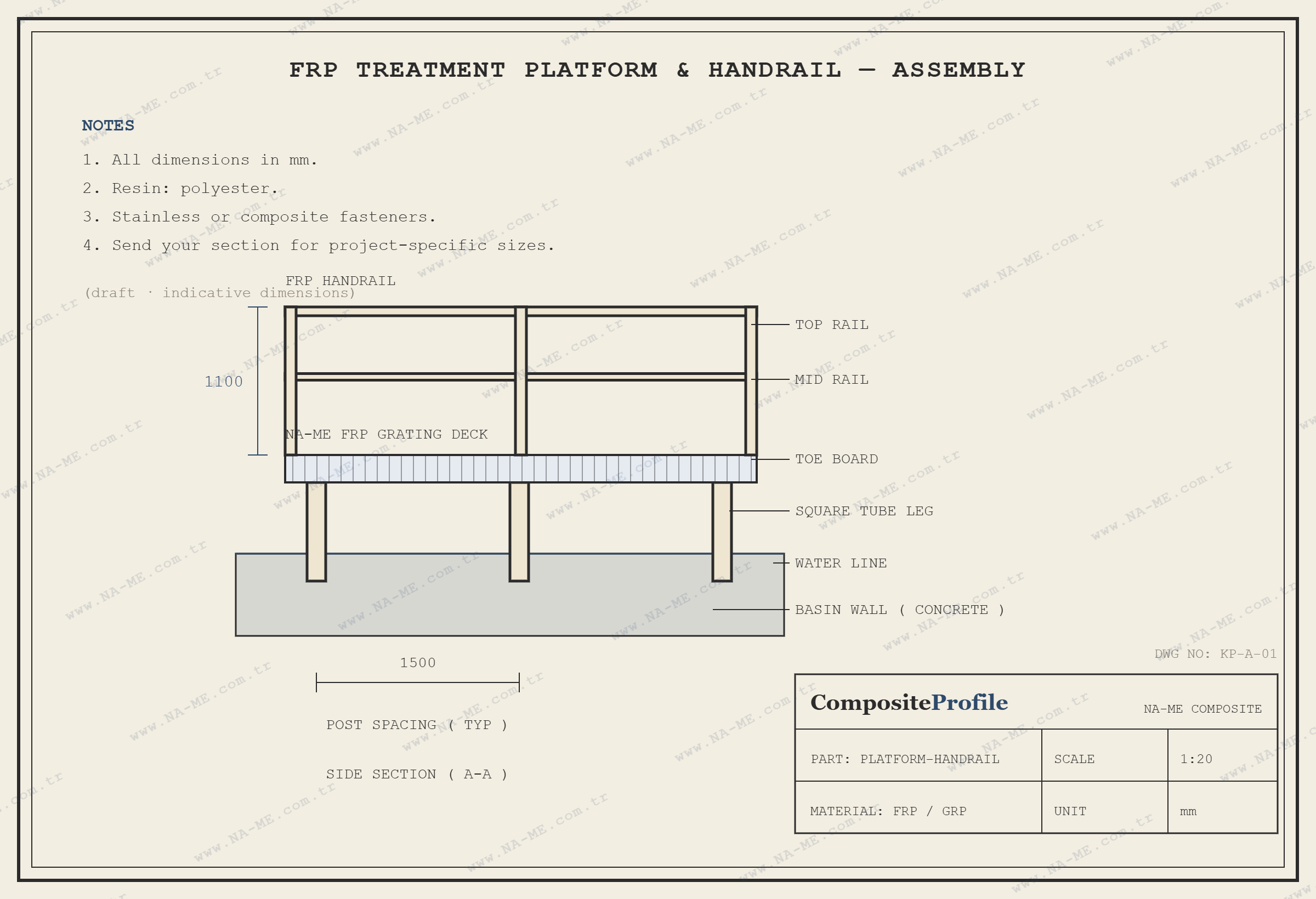
Sketch of a NA-ME FRP grating platform and handrail installation in a water and wastewater treatment plant

A treatment plant is an ideal laboratory for corrosion: relative humidity near a hundred percent, dosing chemicals, biological activity and constant water contact all in one place. Galvanizing thins over time, paint blisters, weld zones rust first. In a composite profile the protection belongs to the material itself rather than to a coating, so a scratch never turns into rust.

Why composite is preferred

  • It does not rust or rot under constant moisture and chemical contact
  • Platforms and covers over basins are light enough to carry by hand, so installation gets easier without shutting the plant down
  • On wet floors a non-conductive structure is an advantage for electrical safety
  • Repeating maintenance items such as painting, rust removal and galvanizing repair disappear
  • Used together with slip-resistant NA-ME FRP grating, pedestrian safety improves

The sections that come forward

U profil I-beamSquare tube AngleC channel
  • I-beam and channel: platform and walkway supports over basins
  • Square tube: handrail posts and top rails
  • Angle: FRP grating fixing, edge connections and brackets
  • C-channel: cover frames and cable or pipe ducts

↳ for the system layout see handrail and platform

field 02

Power and electrical sites

On power sites the main criterion is usually not strength but conductivity. A GRP or FRP profile does not conduct electricity and is not magnetic; in transformer bays, panel rooms, switchyards and cable galleries the support itself stops being a risk. Working safety during maintenance improves and plant downtime shortens.

Why composite is preferred

  • Being non-conductive, it adds a safety margin around live equipment
  • It is non-magnetic and causes no trouble around metering and protection equipment
  • It needs no earthing or cathodic protection and starts no galvanic corrosion chain
  • In open switchyards, weather and UV resistant resin gives long life
  • Where fire behavior matters, a flame retardant resin system is discussed

The sections that come forward

Square tubeU profil AngleI-beam
  • Channel and C-channel: side members for cable ducts and cable ladders
  • Angle: wall and pole brackets, hanger elements
  • Square tube: protection barriers, handrail and fence posts
  • I-beam: beams that span openings

↳ for fastener selection see the installation guide
field 03

Marine and coastal structures

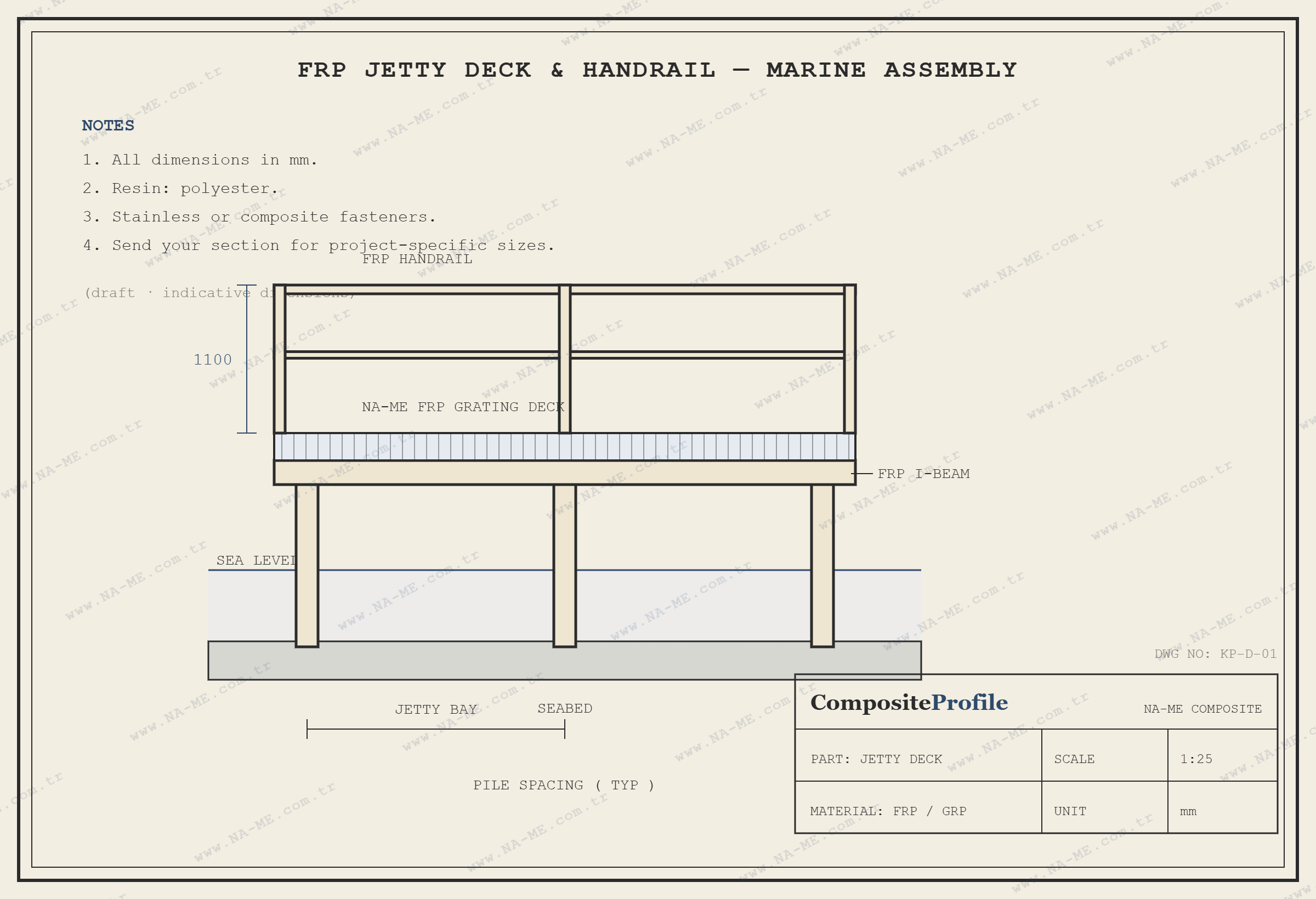
Sketch of a jetty with NA-ME FRP grating decking and handrail on the coast

Salt water and salt spray are among the fastest wearing environments there are for metal. The constant wet-dry cycle tires coatings, and where dissimilar metals meet, galvanic corrosion starts. A composite profile does not rust in salt, needs no cathodic protection or sacrificial anode system, and largely removes maintenance from jetty, platform and handrail systems.

Why composite is preferred

  • It resists salt water and salt air corrosion
  • It creates no need for cathodic protection, sacrificial anodes or regular repainting
  • Being light, it cuts the equipment needed for coastal and over-water installation
  • Algae and sediment build-up do not permanently damage the surface; it washes clean
  • Its non-conductive structure gives safety around electrical equipment over water

The sections that come forward

I-beamU profil Square tubeAngleTee
  • I-beam: main supports for jetties and platforms
  • Channel: intermediate beams, edge bands and decking bearers
  • Square tube: handrail posts and top rails
  • Angle and tee: decking fixing and support elements

↳ stainless fasteners matter especially here
field 04

Solar plant supports

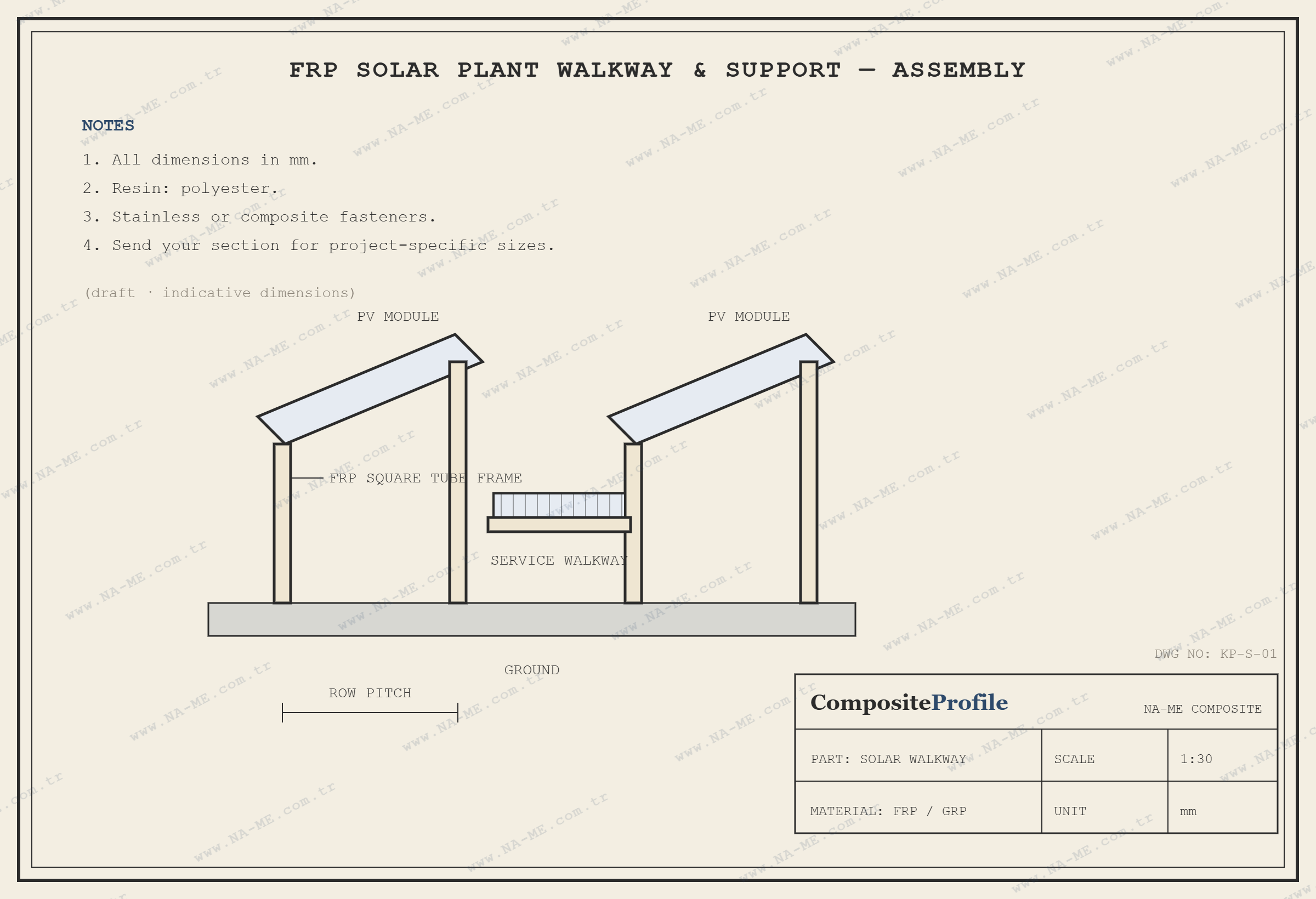
Sketch of composite service walkways and support profiles between panels at a solar power plant

Two things decide on solar sites: installation speed and staying maintenance-free over the long term. A composite profile is light, so work moves fast on site, and it removes the corrosion risk of a metal support in salty, alkaline or damp ground. Around DC lines and panels its non-conductive structure adds safety.

Why composite is preferred

  • Light sections cut handling and installation labor across a wide site
  • UV stabilized resin and a surface veil give long life outdoors
  • In salty and alkaline ground there is no corrosion risk from metal in contact with soil
  • The non-conductive structure adds a safety margin around cables and DC lines
  • It can be cut and dimensioned on site, which shortens waiting on fabrication

The sections that come forward

Square tubeU profil I-beamAngleC channel
  • Square tube and channel: construction beams and intermediate connections
  • I-beam: main support over long spans
  • Angle: panel connection and alignment elements
  • C-channel: cable ducts and cable routing

↳ surface protection after cutting must not be skipped
field 05

Chemical plants and industrial sites

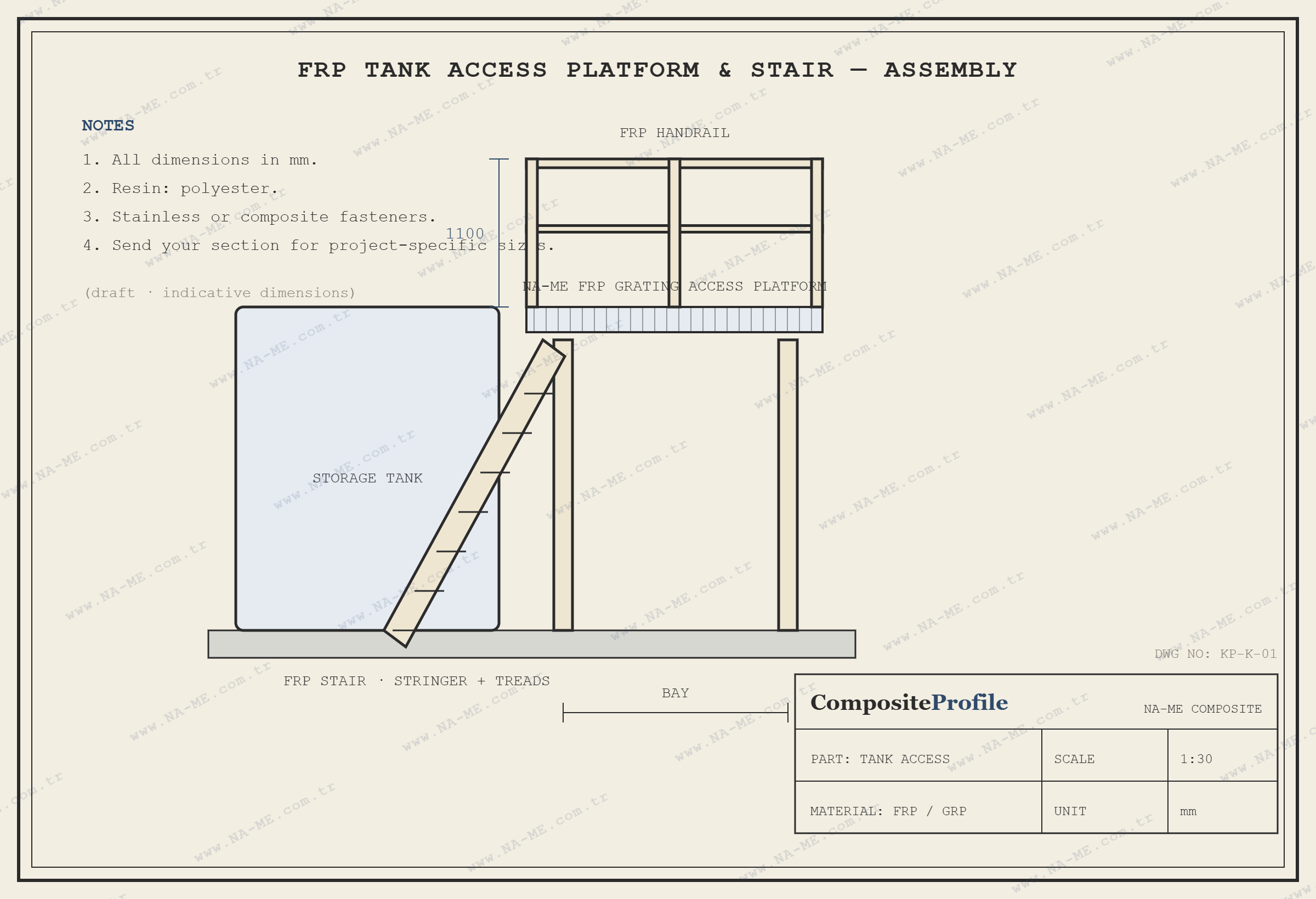
Sketch of a storage tank with a composite access platform and stairs in a chemical plant

On a chemical site, material selection does not end with saying "composite"; what decides is the resin system. Acid or alkali vapor, spill risk, cleaning chemicals and working temperature all directly affect which resin family we work with. That is why we ask more questions before quoting in this field — as we should.

Why composite is preferred

  • With the right resin it shows high resistance to chemical attack
  • In spill and vapor contact it does not depend on a surface coating
  • On pipe supports and platforms, the need to shut the plant down for maintenance drops
  • On wet and slippery floors it can be used together with slip-resistant NA-ME FRP grating decking
  • Electrical insulation adds safety around static and live equipment

Send us these

  • The name of the chemical it will contact
  • Density or concentration
  • Working temperature range
  • Type of contact: continuous, splash or vapor only
  • Cleaning method and the cleaning chemical used

Without this, recommending a resin would be guesswork. We do not guess — we ask.

Polyester resin
process

The field is settled, the section is next

The field of use is only the first sentence of the story. Section and resin become clear in four steps.

1 · Describe the site

Location, environment, chemicals and temperature. A photo or a hand sketch is enough.

2 · Settle the resin

We match the polyester resin to how aggressive the environment is, together with the surface veil and additives for UV and fire requirements.

3 · Settle the section

Channel, I-beam, square tube, angle or a project-specific die, according to load and span.

4 · Produce and deliver

Production, cutting and packing to your dimensions, with a road map for installation and maintenance.

↳ next: handrail and platform · installation · maintenance and service life

next step

Describe your site and we will settle the section together

Send the field of use, the environmental conditions and a sketch of your section if you have one, and we will recommend the right profile, resin and surface veil. Dimensions are enough for a quote — we price it against the job.