Home › Structural Shapes › Angle
Two legs at right angles: the most practical part for joining, edging and corner reinforcement. It does the job even in small sections and is easy to work with on site. Pultruded by NA-ME Composite.
↳ if your leg length is not in the table, tell us the size — we will make it
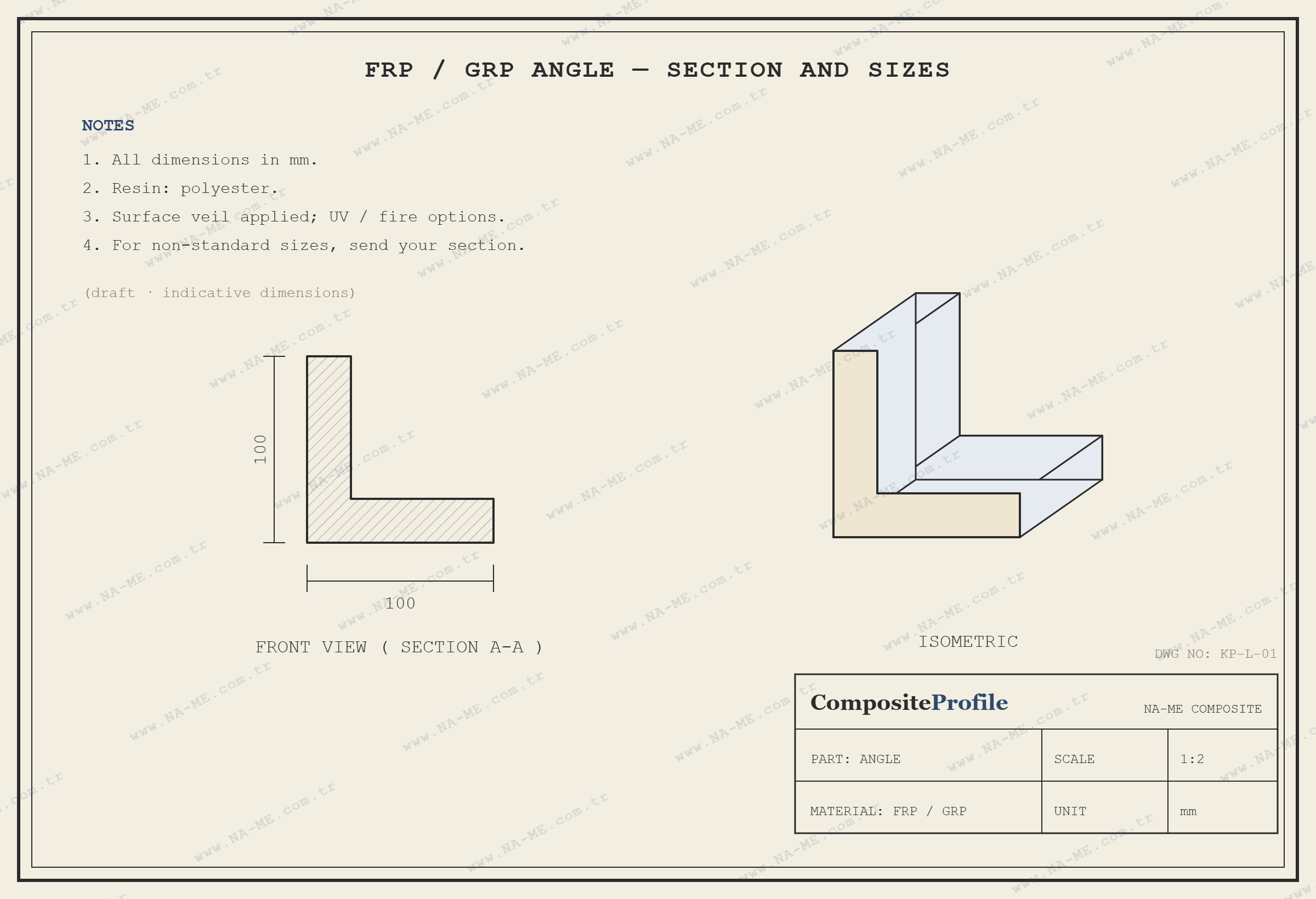
The angle — two legs meeting at 90° — is not a beam that spans on its own; it is the intermediate part that ties two surfaces together, frames an edge or holds a panel in place. Equal legs give you freedom during installation: you decide on site which leg sits horizontal and which vertical. The section is simple, so measuring, cutting and lining up all go quickly.
FRP grating edge frames, platform and catwalk edge trims, handrail base connections, vent and hatch frames, panel corner joints and duct mouth retainers are the classic places for an angle. In these jobs a GRP angle removes the rust and repainting burden of its steel equivalent. When you cut or drill on site, seal the exposed face with resin or gelcoat; that keeps the fiber ends closed to moisture and the edge stays as good as new.
| Code | Leg A (mm) | Leg B (mm) | Wall t (mm) | Weight (kg/m) |
|---|---|---|---|---|
| CPL-O-101 | 20 | 20 | 4 | 0,24 |
| CPL-O-102 | 40 | 40 | 4 | 0,57 |
| CPL-O-103 | 40 | 40 | 5 | 0,65 |
| CPL-O-104 | 50 | 50 | 6 | 1,02 |
| CPL-O-105 | 55 | 36 | 3 | 0,43 |
| CPL-O-106 | 60 | 60 | 5 | 1,02 |
| CPL-O-107 | 60 | 60 | 6 | 1,20 |
| CPL-O-110 | 75 | 32 | 3 | 0,41 |
| CPL-O-108 | 75 | 75 | 6 | 1,61 |
| CPL-O-109 | 75 | 75 | 9 | 2,34 |
| CPL-O-111 | 100 | 100 | 8 | 2,84 |
| CPL-O-112 | 255 | 32 | 3 | 1,13 |
↳ Need a different leg length, unequal legs or a different wall? Send your section and we will make it to order.
An angle usually sits exactly where water collects and cleaning is hard; composite loses no section at those points.
Even long lengths are carried and held in place by one person; framing needs no lifting equipment.
A non-conductive spacer where dissimilar metals meet, breaking the galvanic corrosion chain.
It can be cut and drilled; seal the exposed face with resin and the service life is the same as it left the factory.
Give us the leg length, wall thickness and length (a×a×t plus quantity); tell us where it will be used and we will choose the resin together. We price it against the job — dimensions are enough to start.